How to Clean a Bathroom Exhaust Fan (and Check That It Works)
A dusty bathroom fan moves less air, and a bathroom that stays damp grows mold. Cleaning it takes about 20 minutes and a vacuum, once the power is off.

To clean a bathroom exhaust fan, switch it off at the wall and at the circuit breaker, take off the cover, wash the cover in warm soapy water, and vacuum dust from the fan blades and housing with a brush attachment, then dry everything and reassemble. Afterward, hold a single square of tissue near the grille with the fan running: if it is pulled toward the grille, the fan is moving air. Plan on a clean every few months, more often if the cover looks gray.
Why it matters for mold
A bathroom exhaust fan exists to pull out moist air from showers and baths. When dust coats the cover and blades, the fan moves less air, the room stays damp longer, and mirrors, ceilings and grout stay wet enough for mold. The U.S. EPA’s guidance on mold says to keep indoor humidity below 60 percent, ideally between 30 and 50 percent, and to increase ventilation, such as running a fan or opening a window, where mold keeps returning in showers (EPA brief guide to mold and moisture). A clean, working fan is one of the simplest ways to get there.
What you need
- A stable step stool or ladder
- Safety glasses (dust falls on you when you work overhead) and a dust mask if you are sensitive to dust
- A vacuum with a brush attachment and crevice tool
- Dish soap, warm water and a sink or bucket
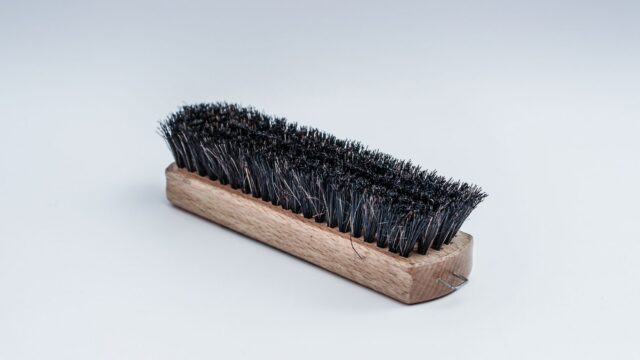
- A soft brush or old paintbrush, and microfiber cloths
- A screwdriver, if the cover or motor is screwed in
Step by step
- Cut the power. Turn off the fan switch, then switch off the circuit breaker that feeds the bathroom. Many fans plug into an outlet inside the housing; if yours does, you can also unplug it once the cover is off. Do not clean a fan that is connected to power.
- Remove the cover. Most covers are held by two springy wire clips. Pull the cover down a little, squeeze the wire clips together and slide them out of their slots. Some covers are held with a center screw instead. If a light is built in, let the bulb cool first.
- Wash the cover. Soak it in warm water with a few drops of dish soap, scrub with a soft brush, rinse and let it dry completely. Do not put a cover with a light fixture or electrical parts in water; wipe those parts with a barely damp cloth instead, following the fan maker’s instructions.
- Vacuum the housing and fan. Use the brush attachment on the blades or blower wheel, the motor housing and the inside of the box. Hold the blades still with one hand so they do not spin. A soft paintbrush loosens stuck dust while the vacuum collects it.
- Wipe, do not soak. Wipe the housing with a cloth that is only slightly damp. Keep water and spray cleaners off the motor and wiring.
- Optional deeper clean. Some fans let you unplug and remove the motor and blower assembly for cleaning. Only do this if the manual describes it.
- Reassemble once everything is dry, restore power at the breaker, and test.
How to check that the fan works: the tissue test
With the cover on and the fan running, hold a single square of toilet paper or tissue just below the grille.
- Pulled up and held against the grille: the fan is moving air.
- Flutters weakly or falls: airflow is poor. Possible causes include dust left in the blower, a stuck backdraft damper (the flap where the fan meets the duct), a crushed or disconnected duct in the attic, or a fan that is too small for the room.
- Loud but weak: the motor may be worn, or the duct is blocked. A rattle often means a loose cover or damper.
Another quick sign: if the mirror is still fogged long after a shower with the fan running, the fan is not keeping up.
Is the fan big enough?
Fan capacity is rated in cubic feet per minute (CFM), printed on a label inside the housing. The Home Ventilating Institute recommends at least 1 CFM per square foot of floor area for bathrooms up to 100 square feet; larger bathrooms are sized by fixtures, with HVI giving 50 CFM each for a toilet, shower or tub and 100 CFM for a jetted tub (HVI bathroom ventilation). A common rule of thumb is to leave the fan running for about 20 minutes after a shower. A timer switch or a humidity-sensing fan makes that automatic.
Where the air goes
A bathroom fan should vent outdoors through a duct, not into the attic or a wall cavity, where the damp air can cause mold and rot. If you can safely see the duct in your attic, check that it is connected at both ends. Fixing duct routing, replacing a fan or adding wiring is a job for a qualified electrician or contractor in most places.
How often to clean it
| Task | How often |
|---|---|
| Vacuum the cover with a brush attachment (cover on) | Monthly, or when it looks gray |
| Remove and wash the cover, vacuum the fan | Every 3 to 6 months, or per the manual |
| Tissue test | Each time you clean, and whenever the mirror stays foggy |
| Check the outside vent flap for blockages (from the ground) | Once a year |
Add it to our bathroom cleaning schedule.
Safety basics
- Always cut power at the breaker before touching anything inside the housing.
- Use a stable step stool and wear eye protection when working overhead.
- Keep liquids off the motor and wiring. Never spray cleaner into the housing.
- If you use any cleaner on the cover, follow its label and rinse it off. If someone swallows, inhales or gets a cleaning product in the eyes, call Poison Control at 1-800-222-1222 (US) or emergency services.
- Burning smells, buzzing without spinning, or a fan that is hot to the touch mean switch it off and call an electrician.
Bottom line
Power off at the breaker, remove and wash the cover, vacuum the blades and housing, dry, reassemble, then do the tissue test. A fan that moves air well, runs long enough after showers and vents outdoors is one of the best defenses against shower mold and pink film.
FAQ
Can I clean a bathroom fan without removing the cover?
You can vacuum the outside of the cover with a brush attachment. For the blades and housing, the cover has to come off.
Why is my bathroom fan so loud after cleaning?
Check that the cover clips are seated and the blower wheel is not touching the housing. Persistent noise can mean worn motor bearings.
Should I run the fan during the whole shower?
Yes, and for a while afterward. A common rule of thumb is about 20 minutes after you finish.
Does a bathroom fan help with smells too?
Yes, it exhausts odors along with moisture, provided it actually vents outside.