How to Clean a Shower Head: The Vinegar Bag Soak and Finish-Safe Options
A bag of white vinegar and a rubber band fixes most weak, spraying-sideways shower heads. Check the maker’s care notes first, because some finishes should only see mild soap and water.
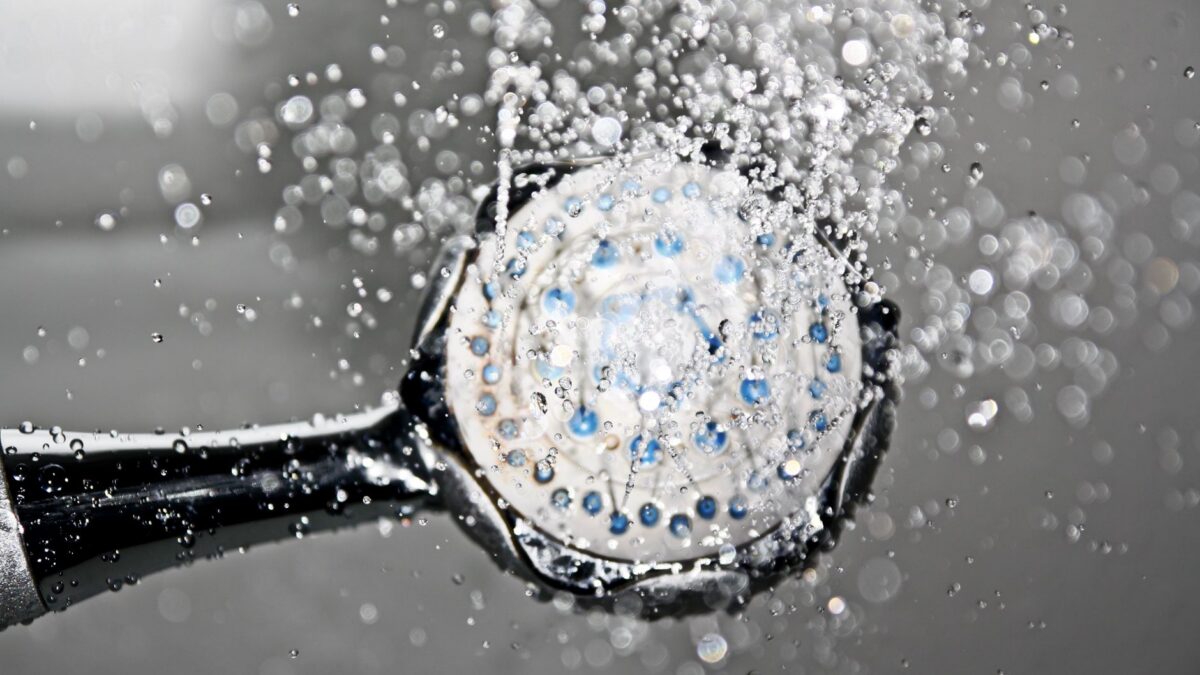
Most clogged shower heads are blocked by hard-water scale, and the usual fix is a soak in plain white vinegar: fill a plastic bag, slip it over the head, secure it with a rubber band and leave it for about an hour (longer for heavy buildup), then rub the nozzles and run hot water through. Before you start, check the care instructions for your finish; some coated or specialty finishes are meant to be cleaned only with mild soap and water. Never add bleach to a vinegar soak.
Why shower heads clog
Hard water carries dissolved calcium and magnesium. When drops dry on the face of the shower head, those minerals stay behind as white or gray crust. Over months, the crust narrows or blocks the spray holes, so you get weaker pressure, jets that spray sideways, or a few nozzles that do not work at all. Vinegar is a mild acid, and acids dissolve that mineral scale.
Many shower heads now have soft rubber or silicone nozzles designed to be rubbed with a finger to break off scale. That helps between deep cleans.
What you need
- Distilled white vinegar
- A sturdy plastic bag (a gallon food bag works) and a rubber band or twist tie
- An old toothbrush and a microfiber cloth
- Optional: a toothpick or straight pin for stubborn holes, and a wrench with a cloth wrapped around the jaws if you remove the head
- Gloves if your skin is sensitive
Method 1: the vinegar bag soak (fixed or removable heads)
- Check the finish. Look up the care sheet for your shower head. Chrome is generally tolerant. Some brushed, matte, bronze-toned, gold-toned and spot-resistant finishes come with instructions to use mild soap and water only and to avoid harsh chemicals and lime-scale removers. If yours says that, use Method 3 instead.
- Fill the bag. Pour in enough vinegar to cover the face of the head when the bag is pulled up around it.
- Attach it. Slip the bag over the head and secure it to the arm with a rubber band. Make sure the nozzles sit fully in the liquid.
- Wait. About an hour handles light scale. Heavy crust may need a few hours. Limit how long the vinegar touches the finish; do not leave a delicate finish soaking overnight.
- Scrub and clear. Remove the bag, rub rubber nozzles with your thumb, and brush the face with an old toothbrush. Use a toothpick on any stubborn holes, gently.
- Flush. Run hot water through the head for a minute or two to push out loosened scale.
- Rinse and dry the outside. Wipe off any vinegar with a damp cloth, then dry with a soft cloth so spots do not form.
Method 2: take it off and soak it (removable heads)
If the head unscrews, you can do a more thorough job.
- Unscrew the head by hand. If it is tight, wrap the nut in a cloth before using a wrench so you do not scratch it.
- Check inside the connection for a small filter screen or flow restrictor. Rinse grit off the screen under the tap.
- Soak the head (not the whole hose, if it has one with a delicate finish) in a bowl of vinegar for the same time as above.
- Scrub, rinse in clean water, and reattach. Wrap fresh plumber’s tape on the threads if the old tape is torn, turning it in the same direction you screw the head on.
- Run water and check for drips at the connection.
For handheld showers, also look at the hose. Kinks or a split inner liner can cause low pressure that no amount of descaling will fix.
Method 3: finishes that need mild soap only
If your shower head care instructions rule out acids and lime-scale removers, follow them; ignoring them can damage the finish and, with some makers, affect the warranty. Wipe the head with warm water and a drop of dish soap on a soft cloth, rub the rubber nozzles to break scale, rinse, and dry. Doing this every week or two keeps scale from building up enough to clog. Some makers do allow a diluted vinegar solution on specific models, so check the manual for your exact model; for example, one manufacturer’s support page for a showerhead suggests mild soap and also allows a 50% distilled white vinegar solution, while warning against abrasives, ammonia and bleach.
Finish-by-finish quick guide
| Finish | Usually safe | Avoid |
|---|---|---|
| Polished chrome | Vinegar soak, mild soap, soft cloth | Steel wool, abrasive powders |
| Brushed nickel / stainless look | Mild soap; vinegar only if the care sheet allows | Abrasives, bleach, long acid soaks |
| Matte black, bronze-tone, gold-tone | Mild soap and water, soft cloth | Acids, lime-scale removers, abrasive pads |
| Plastic heads | Vinegar soak, soap | Solvents, very hot water on cheap plastic |
When the care sheet and this table disagree, the care sheet wins.
How often to clean a shower head
- Every week or two: rub the rubber nozzles and wipe the face dry.
- Every one to three months: a vinegar soak if your water is hard and the finish allows it.
- Whenever the spray looks uneven: that is your sign the holes are narrowing.
Fold it into the routine in our bathroom cleaning schedule. For white crust on faucets, glass and the toilet, see how to remove hard water stains.
Safety basics
Vinegar is mild, but it is still an acid. Never combine it with bleach or a bleach-based cleaner: together they release chlorine gas, and CDC advises never mixing bleach with other cleaners (CDC). If you used a bleach spray on the shower recently, rinse everything with water first. Ventilate, follow any product labels, keep cleaners in their original containers and away from children and pets. If someone swallows, inhales or gets a cleaning product in the eyes, call Poison Control at 1-800-222-1222 (US) or emergency services.
Bottom line
For most heads, an hour in a bag of white vinegar, a scrub of the nozzles and a hot-water flush restores the spray. Read the finish care notes first and switch to mild soap if acids are off-limits. A quick rub of the nozzles every week or two keeps the problem from returning.
FAQ
Can I leave a shower head in vinegar overnight?
Only if the care sheet allows long soaks. Many finishes do better with an hour or two; repeat rather than leaving it overnight.
Is CLR-type lime remover better than vinegar?
Commercial lime and scale removers are stronger acids. Use only on finishes the label and the shower head maker allow, rinse well, and never with bleach.
My shower pressure is still weak after cleaning. Why?
Check the filter screen at the connection, the flow restrictor, a kinked hose, or the valve itself. Weak pressure everywhere in the house is a plumbing issue, not the shower head.
Does a shower head filter stop scale?
Most shower filters target chlorine and are not water softeners, so they do little against hard-water scale. A whole-house softener addresses scale at the source.